
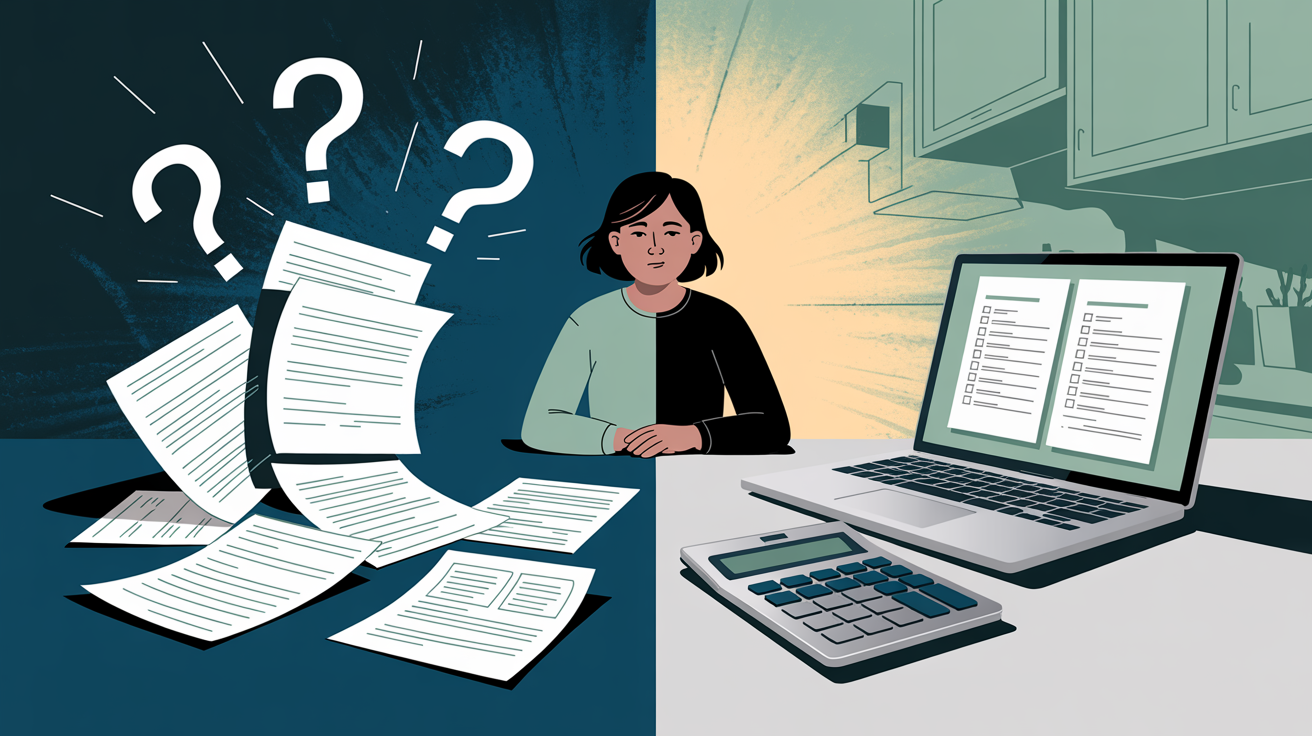
Refinancing My House Should Not Be This Confusing
Refinancing should not feel like a trap.
You want one simple answer.
Will this help me save money or not?
That should not take hours of digging.
But then the process starts.
You see rates, points, fees, APR, escrow, and a pile of forms.
Every lender says they can help.
Every website says something different.
And pretty soon, the whole thing feels harder than it should be.
So let’s clear the table.
No hype.
No lender spin.
No “everybody knows” advice.
Just the bedrock facts that have to be true.
Then we rebuild the refinance decision from zero.
By the end, you should know exactly how to judge a refinance offer without getting lost in the fog.
The Most Skeptical Reader in the Room
Let’s start with the toughest person to convince.
This person has already looked into refinancing.
They may have checked rates online.
They may have talked to a lender.
They may have even started an application.
And now they think this:
“Refinancing is mostly a mess. Every lender says something different, and none of it adds up.”
That reaction makes sense.
It usually comes from a few real experiences:
- A lender advertised a low rate, then the fees looked huge
- A refinance quote promised savings, but the payment barely changed
- An online calculator said one thing, but the lender said another
- A loan officer sounded confident, then underwriting asked for ten more documents
- Every article said “compare rates,” but few explained what actually matters
So the skeptical reader lands on a simple conclusion:
“If the numbers keep moving, the whole thing must be shady.”
That feels fair.
But it rests on a few bad assumptions.
Here are the big ones:
- The interest rate tells the whole story
- A lower payment always means a better deal
- Two lenders with the same rate must be offering the same loan
- If the process feels confusing, the borrower must be missing something obvious
- Refinancing is one decision instead of several smaller ones
Those ideas create most of the confusion.
So let’s strip them away.
Bedrock Fact #1: A Refinance Is Just a New Loan Replacing an Old Loan
That’s the first truth.
A refinance is not a tweak to your old mortgage.
It is a brand-new loan that pays off the old one.
That matters because the lender is not just looking at your past loan.
The lender is judging a new loan today.
So they care about your current picture:
- your credit score now
- your income now
- your debt now
- your home value now
- current market rates now
That explains something many people find maddening.
You can make every mortgage payment on time and still get a weak refinance offer.
Why?
Because the lender is not grading your old loan.
They are pricing a new risk today.
That may feel unfair.
But it is simple.
And once you accept that, the rest starts to make more sense.
Bedrock Fact #2: The Only Real Question Is Whether the New Loan Leaves You Better Off
Not busier.
Not more impressed.
Not excited for five minutes.
Better off.
That means refinancing is not about one number.
It is about the full trade.
You give up one mortgage.
You take on another.
The new one costs money to create.
So the real question is this:
After all the costs, does this new loan improve my situation enough to be worth it?
That is the whole decision.
Not “Is the rate lower?”
Not “Did the lender say it’s a great deal?”
Not “Is the payment smaller?”
Those questions matter.
But they are not the main question.
The main question is whether the trade helps you.
Bedrock Fact #3: “Better Off” Can Mean More Than One Thing
This is where many people get tripped up.
They assume every refinance has the same goal.
It does not.
People refinance for different reasons.
And the right answer depends on the reason.
Common refinance goals
- Lower the monthly payment
- Lower the interest rate
- Pay off the mortgage faster
- Take cash out from home equity
- Switch from adjustable to fixed
- Remove mortgage insurance in some cases
- Create breathing room when other bills get too heavy
Each goal changes how you judge the deal.
For example:
- If your goal is lower monthly payment, a longer term may help
- If your goal is pay less interest overall, a longer term may hurt
- If your goal is cash out, approval and flexibility may matter more
- If your goal is stability, moving from adjustable to fixed may be worth extra cost
This is a big deal.
If you do not know the job, you cannot judge the tool.
So before you compare lenders, fill in this sentence:
“I am refinancing mainly to ______.”
If that blank is fuzzy, the whole process gets fuzzy.
Bedrock Fact #4: A Lower Rate Does Not Automatically Mean a Better Deal
This is one of the biggest traps in the refinance world.
A lender shows you a lower rate.
You feel relief.
Finally, progress.
But a lower rate by itself proves almost nothing.
Why?
Because a mortgage has several moving parts at once:
- the interest rate
- the closing costs
- the loan term
- whether fees get rolled into the balance
Here’s a simple example.
Let’s say you owe $180,000.
You have 20 years left on your mortgage.
Your current rate is 7%.
A lender offers 6%.
That sounds like a win.
But now imagine the lender also charges $8,000 in refinance costs.
And the new loan starts over at 30 years.
Now the picture changes.
Yes, the payment may drop.
But part of that drop may come from stretching the debt over ten more years.
That is not pure savings.
That is slower repayment.
That may still be worth it.
But you need to see it clearly.
A refinance can lower your rate and still be a bad move.
Bedrock Fact #5: Monthly Payment and Total Cost Are Not the Same Thing
This is another place people get fooled.
A lender says, “Great news. Your payment drops by $250 a month.”
That sounds like a win.
Maybe it is.
Maybe it is not.
It depends on why the payment dropped.
Usually, it comes from one or more of these:
- the interest rate fell
- the loan term got longer
- taxes and insurance changed
- fees got added to the new loan balance
Let’s say your payment drops because you moved from 18 years left to a fresh 30-year loan.
Of course the payment fell.
You gave yourself 12 extra years to pay.
That is not automatically bad.
If cash flow is your top goal, it may be exactly what you need.
But if your goal was “save money overall,” this can backfire.
So you need to split one question into two:
- Will this lower my monthly payment?
- Will this lower my total cost over time?
Those are not the same question.
Sometimes the answer is yes to both.
Sometimes it is yes to one and no to the other.
If you mix them together, refinancing gets confusing fast.
Bedrock Fact #6: Closing Costs Are Real, Even When They Get Hidden
A refinance is not free just because you did not bring cash to closing.
This is one of the biggest misunderstandings in the whole process.
Refinance costs can include things like:
- lender fees
- title fees
- appraisal fees
- recording fees
- prepaid interest
- escrow setup costs
Some of these are true costs.
Some are prepayments of bills you would owe anyway.
Some go to the lender.
Some go to third parties.
That mix is exactly why borrowers get confused.
But the main point stays the same:
A refinance has a cost.
You may pay that cost out of pocket.
Or the lender may roll it into the loan.
Or the lender may cover part of it in exchange for a higher rate.
But the cost does not vanish.
It just moves.
That is why “no closing cost refinance” needs a second look.
Sometimes it can be a smart choice.
But usually it means one of two things:
- you are taking a higher rate
- the fees got added to the loan balance
Again, that is not always bad.
But it is never magic.
Bedrock Fact #7: If a Refinance Costs Money, It Needs Time to Pay You Back
This is where break-even comes in.
And it is much simpler than it sounds.
If refinancing costs money, then the new loan should save enough money to earn that cost back.
Let’s use easy numbers:
- Refinance costs: $4,000
- Monthly savings: $200
Now divide $4,000 by $200.
That gives you 20.
So your rough break-even point is 20 months.
In plain English:
If you keep the loan longer than 20 months, the refinance may start paying off.
If you sell, move, refinance again, or pay off the loan before then, the deal may never pay for itself.
This is not the only number that matters.
But it is one of the first numbers you should ask for.
If a lender cannot explain your break-even point clearly, slow down.
That does not mean they are dishonest.
But it does mean you do not yet understand the deal.
And if you do not understand the deal, you should not sign the deal.
Why Refinancing Feels So Confusing in Real Life
Because several different questions get mashed together at once.
People think they are asking one question:
“Should I refinance?”
But they are really asking a pile of smaller questions:
- Can I qualify?
- What rate can I get?
- What fees will I pay?
- Is the payment lower because of the rate or the term?
- How long will I stay in this house?
- Am I trying to save monthly cash or total interest?
- Is this lender truly competitive or just good at marketing?
That is a lot.
And most refinance content does a poor job of separating those questions.
It throws them into one bucket.
Then it wonders why readers feel lost.
Borrowers are not confused because they are bad at money.
They are confused because the process often hides the structure.
So let’s put the structure back.
The 7 Questions That Make a Refinance Decision Much Simpler
If you want to know whether a refinance makes sense, ask these questions in order.
1) What is my main goal?
Pick one main goal.
Not three.
Not five.
One.
Examples:
- lower my monthly payment
- pay less total interest
- take cash out
- move from adjustable to fixed
- free up cash because life got tight
If you do not know the goal, you cannot judge the offer.
2) What is my current loan costing me now?
Know your current facts:
- current balance
- current interest rate
- monthly principal and interest payment
- years left on the loan
Without that, you have nothing solid to compare against.
3) What are the full terms of the new loan?
Not just the rate.
Ask for:
- interest rate
- APR
- loan term
- lender fees
- estimated closing costs
- whether points are included
- whether fees are rolled into the balance
If you compare only rate, you are comparing the wrong thing.
4) Why is the new payment lower or higher?
Do not stop at the payment number.
Ask why it changed.
Was it the rate?
The term?
Escrow?
Rolled-in fees?
You need the reason, not just the result.
5) What is my break-even point?
If the refinance costs money, ask how long it takes to earn that money back.
Then ask the next question:
Will I likely keep this loan that long?
That one question can kill a lot of bad refinance deals.
6) What happens to my total interest over time?
A lower payment can still mean more interest paid over the life of the loan.
That may be fine if cash flow is your top goal.
But you should know it before you sign.
7) Is this the best fit for my goal, not just the lowest ad?
This is the final filter.
If your goal is lower monthly payment, a slightly higher rate with lower fees may still win.
If your goal is long-term savings, a shorter term may win.
If your goal is cash out, flexibility may matter more than a tiny rate difference.
The best refinance company is not always the one with the slickest ad.
It is the one that solves your real problem clearly and cleanly.
What a Good Refinance Conversation Should Sound Like
A good refinance conversation should feel simple.
It should sound something like this:
Step 1: What are you trying to accomplish?
Step 2: Here is what your current loan looks like
Step 3: Here are two or three realistic refinance options
Step 4: Here is how each option changes your payment
Step 5: Here is what each option costs
Step 6: Here is your break-even point
Step 7: Here is which option fits your goal best, and why
That’s it.
Not a secret script.
Not a sales performance.
Just a clean comparison between where you are now and where the new loan would put you.
If a lender cannot explain your refinance this way, the problem may not be you.
The problem may be the explanation.
A Few Refinance Truths That Save People a Lot of Pain
Before we wrap up, here are a few truths worth keeping close.
Truth #1: A refinance can be smart even if it is not perfect
You do not need a unicorn deal.
You need a deal that clearly improves your situation.
Truth #2: A refinance can be bad even if the rate looks great
Low rates can hide high fees, long terms, and weak savings.
Truth #3: “Best lender” lists are often too generic
The best lender for a cash-out refinance may be wrong for a simple rate-and-term refinance.
Truth #4: Feeling confused does not mean you are bad with money
It often means the offer was explained poorly.
Truth #5: You should not move forward until you can explain the deal back in plain English
If you cannot explain it, you do not own the decision yet.
And if you do not own the decision, keep asking questions.
A Quick Note for Businesses in the Refinance Space
If you work in the mortgage, lending, or refinance market, there is another angle worth mentioning.
BestRefinanceCompany.com is a strong exact-match domain for a business that wants a clear, credible brand in this space. It fits a lender, broker, lead gen company, affiliate site, or content business built around refinance education and comparison.
If that kind of digital asset would help your brand or lead strategy, feel free to reach out.
The Bottom Line
Refinancing your house should not be this confusing.
At the bedrock level, it is not.
A refinance is just a trade.
You replace one mortgage with another.
That new loan costs something.
It should improve something important.
And if it does not improve your situation enough to justify the cost, it is not a good refinance.
That is the whole argument.
Not because a lender said so.
Not because a website said rates are falling.
But because the math leaves nowhere else to go.
So if you are staring at refinance offers and feeling buried, step out of the sales pitch and go back to the seven questions.
Name the goal.
Know your current loan.
See the full new terms.
Ask why the payment changed.
Find the break-even point.
Check the total interest.
Then judge the deal by your goal, not by the ad.
Do that, and the fog starts to lift.
If you want a simpler way to think through mortgage and refinance decisions, keep following along. That is exactly what this site is here to do.