
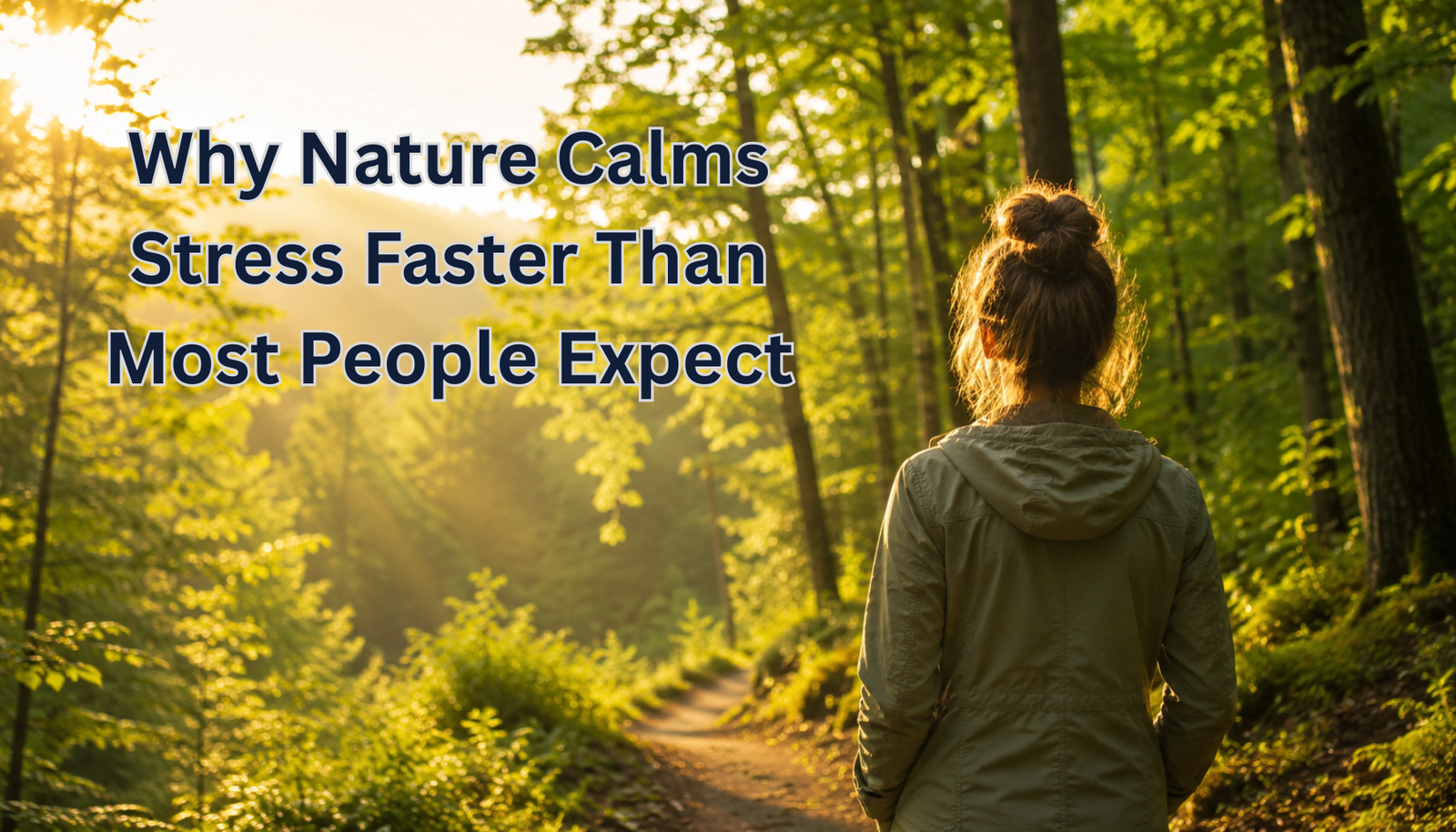
Anyone Else Find Nature Instantly Calming After a Stressful Day?
You step outside after a hard day, and something immediately changes.
Your shoulders loosen, your breathing slows, and your thoughts become quieter.
Nothing caused your problems to disappear during those first few moments.
Yet your body clearly recognizes that it has entered a safer place.
Perhaps you have noticed this shift beside trees, water, or open fields.
Maybe sunlight through your window creates a smaller version of that feeling.
You might wonder whether you imagined the change because you needed relief.
You did not imagine it, and you are certainly not alone.
Nature offers something our crowded, noisy, demanding lives often remove.
It gives the nervous system fewer threats, demands, choices, and interruptions.
That simple change can create relief before your thinking mind catches up.
The Skeptic Has Heard Every Nature Claim Before
Some readers already dislike the phrase “spending time in nature.”
They picture wellness influencers selling expensive retreats beside perfect mountain lakes.
They have heard vague promises about forests healing every human problem.
They also know one walk cannot fix debt, grief, illness, or conflict.
That skeptic deserves something stronger than another cheerful message about fresh air.
Nature does not erase problems or replace needed care and practical action.
Instead, it changes the state in which you meet those problems.
That distinction matters because stress affects every choice you make afterward.
A tense mind sees danger faster and considers fewer possible responses.
A calmer mind notices options that stress had pushed from view.
Nature provides conditions that help this shift happen without demanding performance.
You need no special clothes, beliefs, equipment, or spiritual language.
You do not even need a forest, mountain, or national park.
A backyard tree, neighborhood path, garden, or window view can help.
This claim rests on more than attractive photographs and personal stories.
Research repeatedly links nature exposure with lower stress and improved mood.
One major review found stronger results for reported stress than biological measures.
The same review also found evidence of lower cortisol after nature exposure.
Another systematic review examined both physical markers and personal stress reports.
Its findings supported nature exposure as a useful stress-recovery tool.
The evidence matches what many people already feel within several minutes.
Nature rarely announces its effect through dramatic visions or sudden happiness.
The first sign may simply be one deeper, easier breath.
Why Modern Life Keeps Your Attention Under Pressure
Think about the final hour of an ordinary workday.
Messages arrive while unfinished tasks compete for your shrinking attention.
Someone asks a question while another person needs an immediate answer.
Your phone vibrates, traffic builds, and tomorrow’s responsibilities enter your thoughts.
Each demand asks your brain to select, reject, judge, or respond.
That constant choosing creates a special kind of mental fatigue.
Even pleasant digital content keeps directing and dividing your limited attention.
Nature usually asks much less from your decision-making mind.
A branch moves, but you do not need to answer it.
Clouds change shape, but they require no judgment or quick response.
Birdsong enters your awareness without demanding another item on your schedule.
Your attention still works, but it works in a gentler way.
Researchers often describe this process through attention restoration and stress recovery.
Natural settings hold attention without forcing intense mental effort or control.
The American Psychological Association reports links between nature and improved attention.
It also describes lower stress, better mood, and stronger emotional well-being.
This helps explain why ten quiet minutes can feel surprisingly spacious.
Your brain stops wrestling with dozens of competing signals and demands.
The outdoor world offers movement without urgency and variety without pressure.
That combination gives tired attention a chance to settle naturally.
You may experience the change before consciously noticing any specific detail.
Your eyes soften because they can look farther into the distance.
Your jaw relaxes because nobody outdoors requires an immediate reply.
Your breathing deepens because your body senses fewer urgent social demands.
These changes feel small, but together they reshape your whole experience.
Your Body Often Calms Before Your Thoughts Do
People often try thinking their way out of a stressed state.
They repeat calming words while their bodies remain tight and restless.
That approach can fail because stress does not live inside thoughts alone.
It also appears through breathing, heart activity, muscles, hormones, and alertness.
Nature reaches several of those systems without requiring a mental argument.
Early research compared recovery after people viewed natural and urban settings.
Recovery appeared faster and more complete during exposure to natural environments.
Later research has continued testing both reported feelings and physical responses.
A recent analysis found small-to-medium reductions in physical stress responses outdoors.
Those changes appeared when researchers compared nature with similar urban exposure.
Another study measured stress markers during ordinary personal nature experiences.
Cortisol reductions became strongest during visits lasting roughly twenty to thirty minutes.
You do not need to understand cortisol for nature to help.
Your body responds to surroundings long before you name every response.
Consider what happens when you leave a loud building after hours.
The sudden quiet feels physical, almost like removing a heavy coat.
Nature can offer that release through several senses working together.
Your eyes receive green spaces, wider views, and slower natural movement.
Your ears receive wind, birds, insects, water, and shifting leaves.
Your skin notices sunlight, cool air, warmth, moisture, and changing breezes.
Even natural scents can pull attention away from repetitive stressful thoughts.
These signals tell your body that the environment has changed.
Your nervous system then gains permission to reduce its constant guarding.
That does not mean every outdoor place feels peaceful or safe.
A crowded park or exposed trail might increase stress for some people.
Yet accessible, familiar nature often creates conditions that support genuine relief.
The important point remains simple and deeply useful for daily life.
Your body can begin calming without solving every troubling thought first.
Nature Gives You Relief Without Asking You To Perform
Many stress solutions quietly create another task for exhausted people.
You must follow steps, track progress, remember techniques, or measure results.
You may start wondering whether you are relaxing correctly or quickly enough.
That pressure can turn rest into another test you might fail.
Nature removes much of that performance because it continues without your help.
The tree does not care whether you understand its calming effect.
The stream does not require perfect breathing, posture, gratitude, or concentration.
You can arrive distracted, irritated, tired, doubtful, or emotionally numb.
Nature does not demand a better version of you before offering contact.
That may explain why relief sometimes arrives so quickly and honestly.
Nothing asks you to explain yourself, defend yourself, or appear productive.
You can simply notice one cloud moving behind a roofline.
You can watch grass bend, then rise after the wind passes.
You can listen while rain strikes leaves outside your kitchen window.
Each moment gives attention somewhere safe and simple to rest.
This matters most after days filled with judgment and social pressure.
Perhaps your boss questioned your work during an already difficult afternoon.
Perhaps family tension followed you throughout the drive back home.
Perhaps endless headlines left you angry, worried, and emotionally worn down.
Nature offers company without conversation and presence without personal demands.
That form of company can feel deeply healing after difficult interactions.
It does not replace human support, but it fills another need.
You remember that life contains more than today’s argument or disappointment.
The world becomes larger than the stressful story circling inside you.
Why Water, Trees, and Open Skies Feel Different
Not every natural setting produces the same emotional response for everyone.
Still, several features seem especially powerful after a stressful day.
Trees Offer Strength Without Tension
Trees stand firmly while remaining responsive to wind and changing weather.
Their movement shows flexibility without panic, struggle, or visible resistance.
A tree can become a quiet example for your own body.
You can stand more firmly while allowing tension to move through.
Trees also create shade, texture, depth, sound, and shifting patterns.
Those details engage attention gently without flooding your tired mind.
Water Creates Movement Without Urgency
Water moves constantly, yet its movement rarely appears rushed or anxious.
Waves, streams, and rain provide repeating sounds without exact repetition.
That pattern can interrupt the fixed rhythm of repetitive stressful thinking.
Your problem remains, but your attention stops gripping it continuously.
Research suggests both green and blue spaces can support mental restoration.
Reviews connect these settings with stress relief and improved life satisfaction.
Open Skies Restore Perspective
Stress often narrows attention around one person, event, or feared outcome.
An open sky gives your eyes and thoughts more physical room.
You see distance, movement, light, weather, and gradual change unfolding together.
That wider view can loosen the feeling that one problem contains everything.
The effect is not childish, mystical, weak, or intellectually dishonest.
Perspective changes emotional intensity, even when the facts remain completely unchanged.
You Do Not Need Perfect Wilderness
A common excuse sounds practical because modern people stay genuinely busy.
They say nature works only for people living near beautiful places.
That belief confuses dramatic scenery with everyday contact with living things.
Research has examined parks, gardens, plants, photographs, and nature videos.
A systematic review found relaxed body responses from viewing natural scenery.
Real plants, flowers, and wooden materials also produced helpful physical responses.
Another analysis compared real nature with digital nature for stress recovery.
Both forms reduced stress, with no clear difference between their effects.
Real outdoor contact offers richer smells, sounds, movement, and physical sensations.
Still, digital nature can help people facing illness, weather, or limited movement.
This creates many practical choices during a normal stressful day:
- Sit beneath one nearby tree for ten quiet minutes.
- Watch clouds from your porch without checking your phone.
- Walk slowly around one block containing grass and trees.
- Place a living plant beside your usual reading chair.
- Listen to rain while keeping your screen turned off.
- Watch a short forest video during a crowded indoor day.
- Eat lunch near a window facing natural light.
- Notice birds gathering on wires, rooftops, fences, or branches.
None of these actions require travel, planning, money, or special knowledge.
Their power comes through repeated contact, not impressive scenery or effort.
The Emotional Truth Skeptics Often Miss
People who love nature understand something difficult to explain through statistics.
Nature does not only reduce stress; it changes your relationship with life.
You stop feeling trapped inside one narrow stream of human concerns.
The wind reminds you that movement continues beyond your current trouble.
Sunset shows that endings can hold beauty without denying sadness.
New leaves appear slowly, without announcements, applause, or public approval.
A damaged tree can keep growing around what it cannot replace.
Rain reaches weeds, gardens, forests, rooftops, and forgotten empty lots.
These experiences do not deliver neat advice about your personal situation.
They offer something quieter, older, and sometimes more believable than advice.
They remind you that change, rest, struggle, and renewal belong together.
That emotional truth explains why people return to favorite natural places.
They are not escaping reality through imaginary comfort or empty hope.
They are entering a wider reality that stress had temporarily hidden.
Your deadline matters, but it does not fill the entire sky.
Your mistake hurts, but it does not stop tomorrow’s sunrise.
Your grief remains, but living things continue offering gentle companionship.
Nature helps hold truths that seem impossible to hold alone.
Pain can exist beside beauty without either truth canceling the other.
That experience can feel more honest than forced positivity or quick reassurance.
Why Shared Nature Stories Build Strong Communities
When someone asks, “Does anyone else feel instantly calmer outdoors?” something opens.
The question invites stories rather than instructions, arguments, or expert performances.
One person remembers sitting beneath a maple after losing their job.
Another recalls lake sounds during months of caring for someone ill.
Someone else describes watching birds after a tense family phone call.
These stories build connection because they mirror private moments people rarely discuss.
Many people assume their response to nature feels strange or overly emotional.
Then they discover thousands of others experience the same quiet release.
That recognition produces more than agreement with another interesting health article.
It creates relief, belonging, curiosity, and a reason to return.
People share content that gives language to something deeply personal.
They send it with messages like, “This explains what happens to me.”
That sentence carries more emotional weight than another list of wellness tips.
It says someone finally noticed an experience you could not easily describe.
That feeling creates loyal readers because recognition builds stronger trust.
Try This Before Dismissing Nature’s Effect
After your next difficult day, resist judging this idea from indoors.
Give nature ten focused minutes and notice what actually happens.
Leave your phone behind, or place it completely out of sight.
Choose somewhere with trees, plants, water, sky, or natural sounds.
During those minutes, do not force peace or demand dramatic change.
Instead, notice five concrete things around your resting body:
- Notice one natural movement happening without your control.
- Notice one sound that contains no human words.
- Notice where your body touches the ground or chair.
- Notice whether your next breath arrives more easily.
- Notice one detail you missed during your first minute.
Then compare your body before and after those ten minutes.
Check your shoulders, breathing, jaw, thoughts, heartbeat, and inner pace.
You may not become joyful, inspired, or completely free from worry.
You may simply feel five percent less trapped and hurried.
That small change matters because it shapes your next conversation and choice.
It may stop you from carrying workplace tension into your home.
It may help you answer thoughtfully instead of reacting through exhaustion.
It may create enough space for sleep to begin more easily.
Small shifts repeated often can change the direction of difficult days.
Nature Is Not An Escape From Real Life
Nature does not pull you away from real life and responsibility.
It returns you to life with more room inside yourself.
That is why stressed people seek trees, water, gardens, and open skies.
Their bodies recognize something their busy minds may have forgotten.
Human beings were not built inside endless alerts and crowded schedules.
We still respond to wind, daylight, greenery, birdsong, and moving water.
The research matters because it confirms a widely shared human experience.
Yet your own body can provide the most convincing evidence.
Step outside after your next difficult day and become quietly curious.
Notice what softens before you have time to explain the change.
Then share your experience with someone who carries too much stress.
Ask them whether nature changes their breathing, thoughts, or emotional pace.
That simple conversation may help both of you feel less alone.
Could Our Healing Earth Become Your Next Project?
Perhaps nature does more than help you feel calm.
Maybe it also calls you toward meaningful work.
You might dream about starting a blog, community, nonprofit, or podcast.
You may want to share stories about nature, healing, and hope.
The domain OurHealingEarth.com is currently available for purchase.
It could support a project that helps people reconnect with the earth.
It could also become a home for practical environmental action.
The name offers warmth, hope, and a clear sense of purpose.
For the right person, it could become more than a web address.
It could become the start of something that truly matters.
Step outside today and notice what begins to soften.
Then consider how you might help others feel that connection too.
If that calling feels real, OurHealingEarth.com may offer a place to begin.