
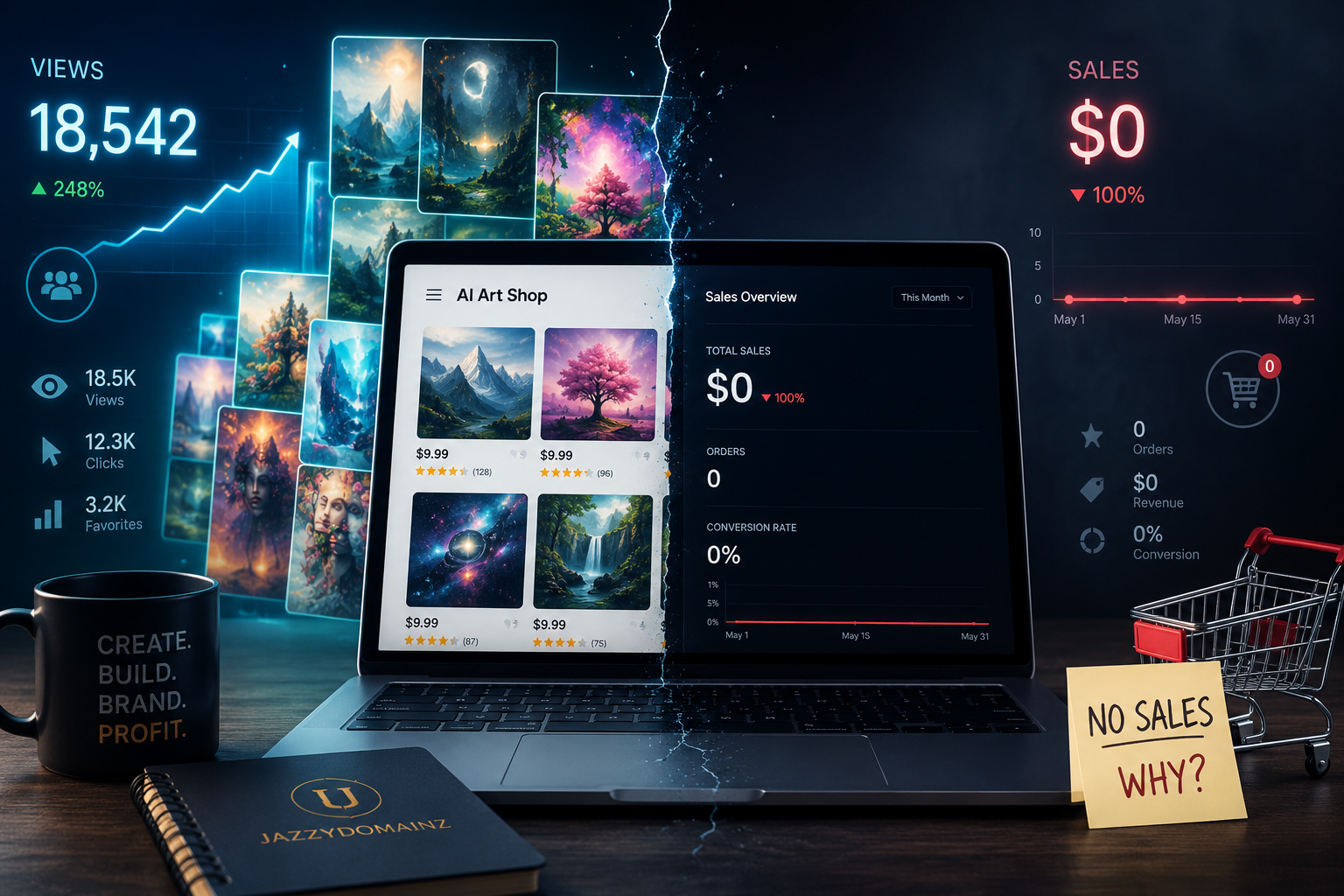
You are not crazy.
Your AI images may look good.
Your listing may even get views.
But if nobody buys, something specific is broken.
The skeptical person reading this has heard every promise before.
They tried Etsy, Fiverr, Gumroad, or print-on-demand.
They watched the tutorials.
They bought the tools.
They made “beautiful” images.
Then the sales did not come.
So let’s be honest.
Views are not the goal.
Sales are the goal.
And views without sales mean one thing.
People are curious, but not convinced.
Views Mean Interest, Not Trust
A view is only a glance.
It does not mean someone wants your product.
It means your title or main image made them pause.
That is useful.
But it is not enough.
A buyer needs more than a pretty picture.
They need a reason to spend money.
They ask fast questions in their head:
- Can I use this today?
- Does this solve my problem?
- Is this better than free options?
- Do I trust this seller?
If your listing fails those questions, they leave.
That is why views can feel so frustrating.
They create hope.
Then they expose the weak spot.
Pretty AI Images Are Not Products
This is the biggest mistake in the whole market.
A pretty AI image is not always a product.
A product has a clear use.
A buyer knows what to do with it.
“Fantasy forest art” sounds nice.
But “printable nursery wall art for a woodland baby room” sounds useful.
That second version has a buyer.
It has a room.
It has a purpose.
It has a reason to exist.
People do not buy images just because they look good.
They buy outcomes.
They buy a finished room.
They buy faster design work.
They buy a gift.
They buy a shortcut.
Your listing has to show that shortcut fast.
The Buyer May Not Know Who Your Listing Is For
Many AI image sellers try to stay broad.
That feels safer.
But it usually hurts sales.
A broad listing sounds like it is for everyone.
In real life, that makes it feel like it is for no one.
“AI clipart bundle” is weak.
“Cute bakery clipart for small business menus and signs” is stronger.
Now a bakery owner can picture using it.
A cake shop owner can imagine it on a menu board.
A café owner can see it on Instagram.
That is the shift you want.
You stop selling “images.”
You start selling a use case.
Your Thumbnail Gets The Click, But The Listing Loses The Sale
This happens all the time.
The first image earns attention.
The rest of the listing fails to close the deal.
Your listing images should not only show the art.
They should answer the buyer’s doubts.
Show the files in use.
Show a framed mockup.
Show a printable page.
Show a sticker sheet.
Show a book cover sample.
Show a menu example.
Show what the buyer gets.
Show the file sizes.
Show the formats.
Show how simple it is to use.
Confidence sells.
A pretty preview gets the click.
A clear preview gets the sale.
Your Offer May Feel Too Thin
A lot of AI image listings feel light.
The buyer sees one image or a small pack.
Then they compare it to larger bundles nearby.
That does not always mean you need more files.
But it does mean you need stronger value.
Here are a few easy ways to strengthen the offer:
- Include multiple sizes
- Add PNG, JPG, and print-ready PDF files
- Offer transparent background versions
- Add matching color variations
- Include a short usage guide
- Make the license terms easy to understand
- Add a small bonus pack when it makes sense
The goal is simple.
You want the buyer to feel safe.
You want the product to feel complete.
Price Is Not The Real Problem Most Of The Time
A lot of sellers assume price is the issue.
Sometimes it is.
But often it is not.
A cheap listing can still feel risky.
A higher-priced listing can still feel fair.
The real question is this:
Does the value feel obvious?
If your listing costs $7, prove $7 fast.
If it costs $19, prove that even faster.
Show what they get.
Show how they use it.
Show how much time it saves.
Show why it looks better than doing it alone.
Do not make buyers guess.
Guessing kills sales.
AI Images Have A Trust Problem
This part matters more than many sellers admit.
Buyers have seen bad AI products.
They have seen weird hands.
They have seen blurry files.
They have seen fake mockups.
They have downloaded products that looked great in the preview and awful in real life.
So they do not trust fast anymore.
That means your listing has to reduce risk.
Be clear about what the buyer receives.
Be clear about the file types.
Be clear about image size and resolution.
Be clear about what the license allows.
Be clear about whether commercial use is included.
Be clear about what is not included.
Trust does not come from hype.
Trust comes from clarity.
Your Title May Be Pulling In The Wrong Traffic
This one surprises people.
You can get views from the wrong crowd.
That sounds good at first.
But bad traffic does not help.
A title like “beautiful AI art” attracts curiosity.
A title like “printable boho wall art for bedroom decor” attracts buyers.
One title attracts browsing.
The other attracts people who want to use the product.
That difference matters.
You want buyer-intent traffic.
Use words that signal use:
- Printable
- Clipart
- Commercial use
- Book cover
- Wall art
- Sticker bundle
- YouTube thumbnail
- Planner pages
- Social media templates
These words tell the buyer what the product actually does.
That is what turns a click into a sale.
Your Product May Look Too Generic
AI makes sameness very easy.
That is one of the biggest traps in this market.
Many sellers use the same prompts.
They create the same glossy look.
Then buyers see five similar listings in a row.
When that happens, your listing becomes easy to ignore.
You need a sharper angle.
Not just “cute animals.”
Try “woodland animals for baby shower games and nursery prints.”
Not just “fantasy portraits.”
Try “dark fantasy character portraits for tabletop campaigns.”
Not just “floral art.”
Try “moody vintage flowers for printable journal covers.”
Specific beats pretty.
Specific feels useful.
Specific feels intentional.
And intentional sells.
Your Description Is Listing Features, Not Selling The Moment
A lot of descriptions are too flat.
They list file types.
They list sizes.
They list the number of images.
That information matters.
But it is not enough.
You also need to sell the moment after the sale.
What happens when the buyer downloads this?
Do they finish a room makeover?
Do they create a better listing?
Do they post cleaner social content?
Do they save two hours of design work?
Do they make a quick gift?
Do they improve a product launch?
That is the real sale.
Here is a simple way to structure the description:
- Name the buyer
- Name the use case
- Name the result
- List the files included
- Remove doubt with clear details
That order works because it mirrors the buyer’s thinking.
First they ask, “Is this for me?”
Then they ask, “What do I do with it?”
Then they ask, “What exactly do I get?”
You May Be Skipping Proof
Proof matters more than most sellers think.
Even small proof helps.
Show close-up detail shots.
Show the full bundle laid out clearly.
Show before-and-after use when possible.
Show exactly what the download includes.
Show a clean file preview.
Show the dimensions.
Show the color versions.
Show the file names if needed.
The buyer wants to feel this:
“This seller thought this through.”
That feeling matters.
It lowers fear.
And lower fear leads to more sales.
The Market Is Not Dead. Weak Offers Are.
You will hear people say AI image products are dead.
That is lazy advice.
Bad offers are dying.
Lazy listings are dying.
Generic bundles are struggling.
But useful visual products still sell.
People still need images.
They need wall art.
They need clipart.
They need printable party packs.
They need book covers.
They need thumbnails.
They need visual assets for small businesses.
They need social media graphics.
They need shortcuts.
The market did not disappear.
It just got less forgiving.
That is actually good news.
It means better sellers still have room to win.
Fix The Sale Before You Blame The Views
Views are data.
They are not proof that the market hates you.
If you are getting views, something is already working.
Your listing is catching attention.
Now you need to fix the conversion.
Ask these questions:
- Is the buyer clear?
- Is the use case clear?
- Is the value clear?
- Are the file types clear?
- Is the license clear?
- Is the result clear?
- Do the preview images build trust?
- Does the offer feel complete?
Do not change ten things at once.
Fix one weak spot first.
Then test again.
The Same Rule Applies To Your Brand
Here is one more thing many sellers miss.
Generic AI image listings struggle because they blend together.
Generic AI image brands have the same problem.
If you want to build more than one product, your name matters.
A strong name helps people understand you faster.
That matters in a crowded market.
This is why a domain like AIImageHQ.com fits the space so well.
It sounds like a central place for AI images.
It could work for prompts, tools, tutorials, image packs, or creator resources.
It also has a strong “main hub” feel.
That matters if you want buyers to trust you.
Because the goal is not just to make pretty images.
The goal is to build something people remember.
The Truth Most Tutorials Skip
Most tutorials make the same mistake.
They focus on image creation.
They barely touch the business side.
But AI image money does not come from making pretty files.
It comes from product thinking.
The image is the raw material.
The listing is the sales page.
The buyer is the judge.
The use case is the bridge.
When your listing gets views but no sales, the market is telling you something useful.
It is not saying your images are worthless.
It is saying your offer is not clear enough yet.
That is a very different problem.
And it is fixable.
Conclusion: Views Are The Beginning
Getting views but no sales hurts.
But it is not the end.
It is the first honest signal.
People noticed your product.
Now your job is to make buying feel obvious.
Clarify the buyer.
Sharpen the use case.
Strengthen the offer.
Show the result.
Remove the risk.
And if you want to build a larger AI image business, think bigger than a single listing.
A strong domain like AIImageHQ.com can help anchor that brand.
Pick one listing today.
Rewrite it for one clear buyer.
Then make every image, title, and line of copy support that sale.